
A title tag CTR test should measure more than whether the click-through rate increased after an edit. Position, query mix, device, country and the displayed title can all change the result. Define the hypothesis and comparison before rewriting the page title.
This article describes a study method, not a completed experiment. No title intervention or measured gain is claimed. The numerical example below is hypothetical and only explains how to interpret the metrics.
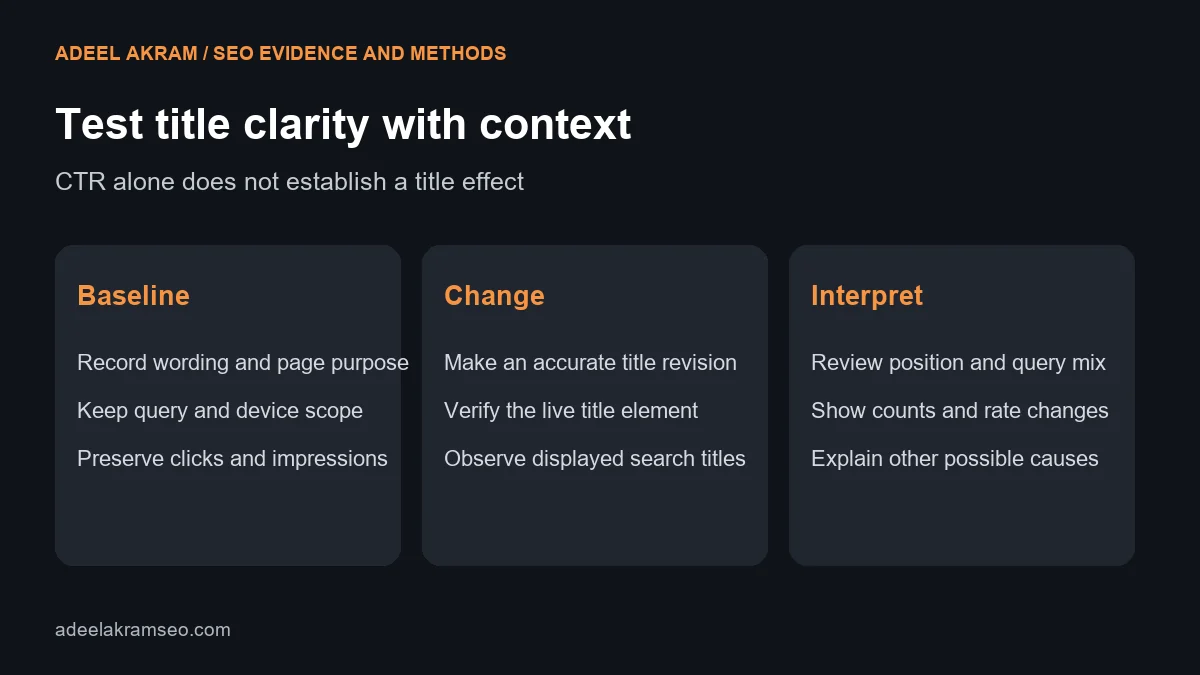
Choose a relevant title problem
Select a page where the current title is unclear, repetitive or poorly aligned with the actual answer. The proposed revision should help a suitable searcher understand the page. Do not use a misleading promise merely to increase clicks.
Google’s title-link guidance recommends descriptive, concise titles and explains that Google may use several sources to determine the displayed title. Editing the title element does not guarantee that exact wording will appear for every query.
Record the original title, visible main heading and proposed alternative. Explain the expected improvement in plain language, such as clarifying the page’s audience or the problem it solves.
Define the study scope and baseline
Choose the page, relevant query group, search type, country and device segment. Use an observation period appropriate to the volume and business context. A page with very few impressions may not support a useful short test.
Preserve clicks, impressions, CTR and average position for the baseline. Google’s Search Console performance guidance defines CTR as clicks divided by impressions and describes the available dimensions. Keep the scope consistent when comparing periods.
Note seasonal demand, campaigns, ranking updates and other page changes. Avoid changing the title, content and internal links together when the intended question concerns only the title. If other work is necessary, record it and limit the conclusion.
Build a reviewable test record
| Record | What to preserve | Reason |
|---|---|---|
| Hypothesis | Why the revised title should help | Defines the intended mechanism |
| Original and new title | Exact text and live dates | Makes the intervention reproducible |
| Page context | Main heading and content purpose | Checks that the promise remains accurate |
| Search scope | Query group, country, device and type | Prevents mismatched comparisons |
| Baseline metrics | Clicks, impressions, CTR and position | Provides the starting observation |
| Displayed title observations | Dated checks under recorded conditions | Shows whether the visible treatment matches the plan |
| Other changes | Page edits, releases and campaigns | Exposes alternative explanations |
| Review outcome | Counts, interpretation and limitations | Avoids presenting one metric as proof |
Verify the live change
After implementation, inspect the public title element and heading. Confirm that the expected value reached the live page and that a template or cache did not retain the old version. Record the date the change became visible.
Allow for search systems to process the page. A live edit is not the same as a confirmed displayed search title. Preserve dated observations and do not claim the treatment was visible everywhere based on one search.
Do not repeatedly rotate the wording during the same observation period without defining a new phase. Otherwise, the report may attribute a result to a title that was present for only part of the test.
Interpret CTR together with position and query mix
CTR can change because the result appears at a different position or reaches a different set of searches. An aggregate rate can hide those changes. Compare relevant segments and review whether the page attracted new informational or commercial queries.
Average position is an aggregate, not a complete distribution. Two periods with a similar average can still differ across queries and devices. Use the available detail to explain what the comparison can support.
A simple before-and-after result is observational. Even with a comparison group, differences in demand or competing results may remain. State the limits rather than calling every increase a causal lift from the title.
Use counts to understand the hypothetical result
Suppose a page records 50 clicks from 1,000 impressions before the edit: its CTR is 5%. Suppose it later records 60 clicks from 1,000 impressions: its CTR is 6%. That is a one-percentage-point increase and a 20% relative increase in CTR. These numbers are illustrative, not website or client results.
Before attributing that change to the wording, inspect position, queries, country, device and displayed title. If the result moved substantially higher, position may explain part of the observation. If the query mix changed, the aggregate comparison may not describe the same audience.
More clicks also do not automatically mean better leads. A title that attracts unsuitable visitors can improve CTR while weakening the business outcome. Review whether the page delivers the promise and supports a relevant next step.
Report the conclusion without rewriting the goal
Classify the outcome as supported, mixed, not observed or inconclusive under the study’s conditions. Include counts and the main alternative explanations. Do not remove a negative finding simply because it makes the case study less dramatic.
If the evidence favors the clearer title and it accurately represents the content, keep it and document the reasoning. If the sample is too small, acknowledge the gap. If the change misleads readers, correct it regardless of the rate.
The SEO audit checklist can help place the test in context. A title experiment is less useful when access, indexing or the inquiry path has an unresolved failure.
Questions about a title tag CTR test
Does editing the title guarantee a new Google title link?
No. Google uses several sources and may display different wording. Record the actual observations separately from the live title element.
Is higher CTR proof the title caused the improvement?
No. Position, query mix and other conditions can change. The study must examine those factors and explain its limits.
Should the test use clickbait?
No. Improve clarity and relevance while accurately representing the content. Suitable visits matter more than misleading clicks.
Has this test already produced results?
No. This is an experiment method with a hypothetical calculation. A completed report needs actual dated records.
Test clarity with a reliable comparison
Choose one relevant page, preserve the baseline and define the title change. Verify deployment and review the search evidence with position and audience context. For help evaluating page titles and content, request an SEO review. A credible CTR test explains more than the percentage.