
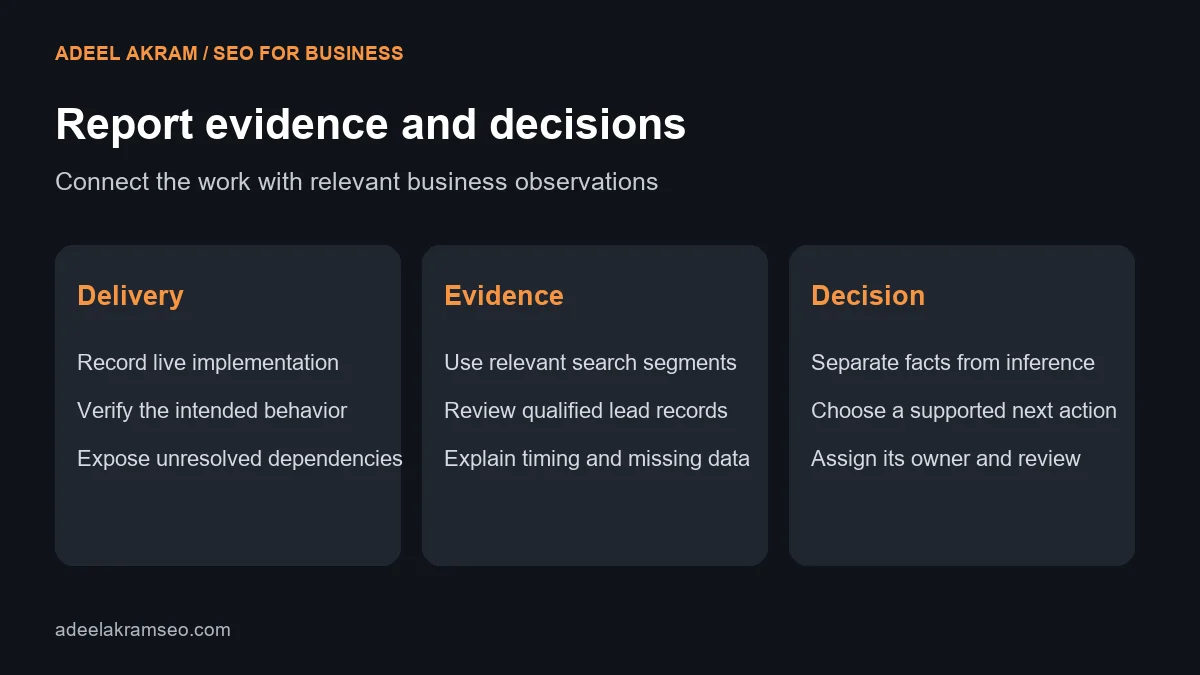
Useful SEO reporting tells a business owner what changed, what the evidence means and what decision comes next. Rankings and traffic provide context, but they do not automatically establish suitable inquiries or revenue. A report should connect completed work with relevant observations while explaining the limits of attribution.
Use a concise decision summary supported by a consistent set of metrics. The goal is not to hide detail; it is to make the important conclusions understandable before the reader opens the supporting tables.
Start with the business question
Define the services, locations and outcomes the work supports. A report for a local service business may focus on suitable inquiries. A migration report may focus first on URL preservation and access. The same dashboard is unlikely to answer both questions well.
Write the reporting period and comparison basis. Explain whether figures refer to visits, leads created, opportunities opened or contracts signed during that period. Those groups may overlap without representing the same customers.
Separate delivery from results
List the important work that reached the live website and the checks that verified it. Include implementation dates, responsible owners and unresolved dependencies. Recommendations awaiting approval belong in a separate backlog rather than the completed-work section.
Then explain the relevant observations. A repaired form can establish that inquiries now reach the inbox. A change in traffic may have several possible causes. Keep verified behavior separate from an interpretation about business impact.
Use the SEO audit checklist to connect a technical backlog with meaningful checks. A tool score can help spot issues, but it is not a substitute for verifying the actual page or workflow.
Choose a small set of useful metrics
| Metric or record | Business question | Context to include |
|---|---|---|
| Relevant search clicks | Are suitable topics bringing recorded visits? | Page, query group, country and comparison period |
| Priority landing-page visits | Are visitors reaching the offer? | Source, device and page purpose |
| Successful inquiry actions | Are contact paths producing recorded actions? | Event definition and recent test status |
| Qualified leads | Do inquiries fit the service? | Qualification criteria and lead creation dates |
| Sales progress | What happened after the inquiry? | Cohort, delay and CRM completeness |
| Revenue associated with lead records | What business followed recorded discovery? | Attribution assumptions and date basis |
| Completed implementation | Did the team execute the plan? | Live verification and remaining blockers |
| Next actions | What decision follows the evidence? | Owner, priority and review point |
Keep search and analytics scopes clear
Search Console and website analytics describe different parts of the journey. Search data can show recorded impressions and clicks. Website analytics can describe observed sessions and actions. Differences between them do not automatically mean either tool is broken.
Label the scope when using acquisition or attribution views. First-user acquisition, session acquisition and credit for a key event answer different questions. Google’s attribution overview explains how models assign credit to available touchpoints. A model is not a complete record of every influence on a buyer.
Do not add platform views, website visits and CRM leads into one total called customers reached. The same person may appear in several systems, and their counting rules differ. Report each signal according to what it measures.
Show inquiry quality and sales timing
Agree on a definition of a qualified lead with the team handling inquiries. Service fit, location and genuine need can matter more than submission volume. Keep spam, duplicates and unsuitable requests visible as separate categories.
Review leads by creation period when following them through the sales process. A lead created in March may close in May. Comparing May contracts with May inquiries without that context can produce a misleading close rate.
If the CRM lacks reliable updates, say so. Do not fill missing outcomes with assumptions or treat every open opportunity as future revenue. Improve the handoff process before presenting a precise commercial conclusion.
Explain changes rather than only displaying them
For each important movement, describe the affected segment, timing and possible explanations. Check seasonality, new campaigns, website releases and changes in service availability. A rise in unrelated article traffic can coexist with no change in visits to the offer.
Use counts alongside percentages when the sample is small. One additional inquiry can create a large percentage change without establishing a stable trend. Explain whether the observation supports action now or whether more evidence is needed.
Use plain confidence labels: verified, supported interpretation or unresolved. For example, a live form test can verify delivery. A traffic increase after a content change may support an interpretation but does not prove the change alone caused it.
End with decisions, owners and blockers
Choose a short list of next actions tied to the observations. A broken inquiry path needs repair. An unclear service page needs a focused revision. Missing measurement needs a test plan. Avoid ending every report with the same instruction to publish more articles.
Assign an owner and review point to each action. Include what the team needs from the business, such as a developer release or expert review. If a dependency prevents progress, make it visible rather than allowing it to disappear into the monthly summary.
Keep the underlying evidence accessible to the appropriate people. Public case studies should remove private data and use permission where required. Internal reporting can be detailed without exposing customer records in a broadly shared presentation.
Questions about SEO reporting
Should rankings appear in the report?
They can provide context for relevant queries. Explain location, device, period and measurement method, and connect them with the business question.
Is more traffic always a positive result?
No. Check the audience, landing pages and inquiry quality. Traffic unrelated to the offer may serve another purpose without increasing suitable leads.
Can analytics prove every SEO sale?
No. Measurement may miss private sharing, offline influence or cross-device behavior. Report recorded associations and attribution assumptions clearly.
How long should the report be?
Use a concise decision summary with supporting detail available. Include enough evidence to evaluate the conclusions without overwhelming the reader with unrelated metrics.
Make the next review useful
Agree on the business question, baseline, definitions and implementation log before producing the next report. Then connect the observations with a manageable action list. For help building clearer measurement and review, contact Adeel Akram. A useful report improves the next decision, not only the next chart.