
An SEO audit case study should show the route from a confirmed finding to an implemented change and a reviewable outcome. A before-and-after chart without that record leaves the reader guessing about what actually happened. Document the baseline, priorities, owners, live checks and the limits of the result.
This article provides a documented review method. It does not claim a completed client implementation or invent traffic, ranking or revenue gains. Use it to prepare a real account when the required evidence exists.
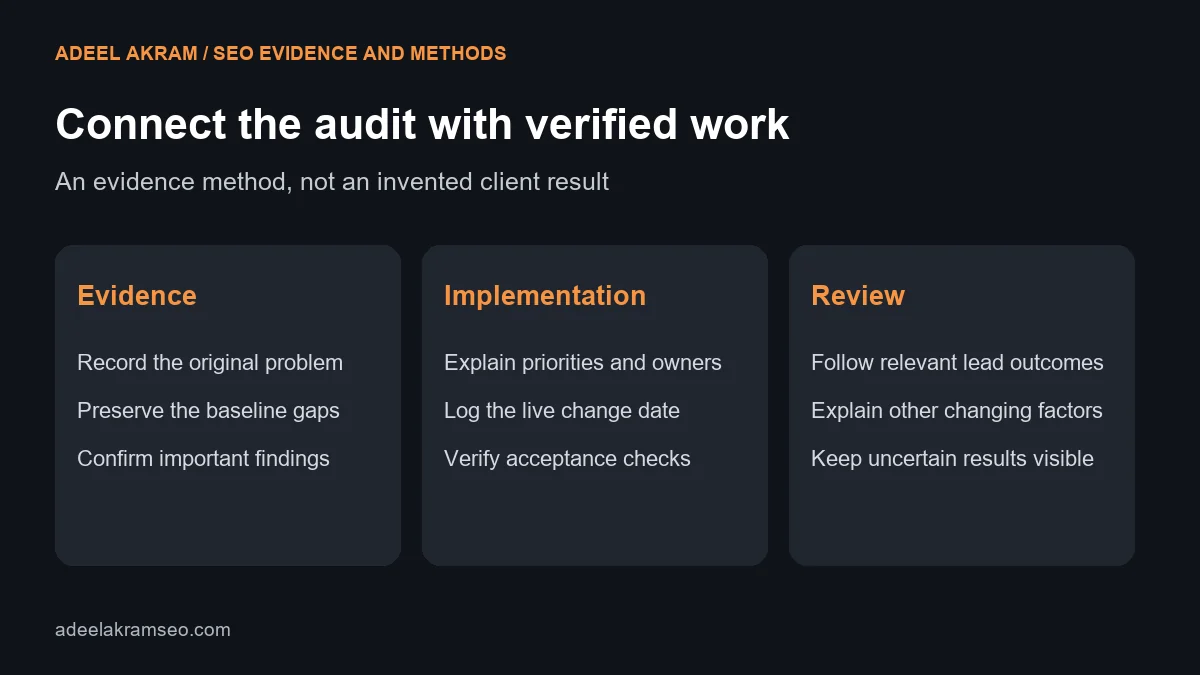
Define the original problem and scope
Start with the business issue that triggered the audit. A decline in suitable inquiries, a migration risk and an indexing failure require different evidence. State the website sections, period and outcomes the review covers.
Record the available baseline and gaps. Include relevant page behavior, search data, inquiry measurement and recent changes. Do not treat a tool export as a complete picture of the business problem.
The SEO audit checklist helps organize coverage. The finished case study should explain which areas mattered and why, rather than reproduce every item regardless of relevance.
Turn findings into a priority decision
For each important finding, preserve the affected example and supporting evidence. Describe the consequence and confidence. Separate confirmed defects from possible improvements and unresolved questions.
Choose the first batch using impact, reach, effort, risk and dependencies. Explain why an issue came before another. A report with many warnings should not imply that the team must complete all of them before making progress.
Document exclusions and deferred work. A clear reason for leaving a low-value refinement until later can be more useful than claiming every audit item was urgent.
Create the implementation evidence chain
| Stage | Evidence to preserve | Question it answers |
|---|---|---|
| Problem | Business goal and observed issue | Why did the project begin? |
| Baseline | Relevant dates, pages and measurement gaps | What was the starting condition? |
| Finding | Live examples and supporting data | What was actually wrong or uncertain? |
| Priority | Impact, effort and dependencies | Why did this action come next? |
| Ticket | Owner, intended behavior and acceptance check | Who would change what? |
| Deployment | Live date and change log | When did the intervention occur? |
| Verification | Observed behavior after release | Did the intended change work? |
| Outcome review | Relevant metrics, timing and limitations | What changed and what can be concluded? |
Assign owners and acceptance checks
A recommendation needs a route to implementation. Identify the developer, content reviewer or business owner who can complete the task. Confirm the approval and release process so the audit does not end as an unused report.
Write an acceptance check that describes the live behavior. A redirect ticket should identify the expected destination. A form ticket should verify successful submission and receipt. A content ticket should check the intended answer and offer.
Avoid closing a task merely because someone changed a setting. The public output may differ because of caching, templates or a missed dependency. Preserve the live observation that establishes completion.
Keep a dated change log
Record the actual deployment date and the affected pages or templates. Include other significant releases, campaigns and business changes during the same period. They may influence later observations.
Separate planned, completed and verified work. A planned content update is not a live intervention. A completed edit is not a verified fix until the acceptance check passes. These distinctions make the case study understandable.
Capture enough evidence to reproduce the review without publishing private records. Store sensitive business details in the approved internal system and use appropriate permission for a public client account.
Review technical behavior before search outcomes
First verify that the intended access, navigation, content or inquiry behavior changed. For an indexing investigation, distinguish the stages with the page indexing diagnosis. A page becoming accessible is not the same as ranking first.
Then review relevant search observations after an appropriate period. Google’s Starter Guide explains that search effects vary in timing and may not be noticeable for every change. Keep implementation proof and performance interpretation separate.
Report regressions as well as improvements. A technical fix that breaks a form or removes useful content needs attention even if one metric improves. A complete account includes the functional review.
Connect the review with suitable business outcomes
Use trustworthy inquiry records and consistent qualification criteria. Separate contact clicks, successful submissions and suitable leads. Follow the relevant lead cohort when reviewing later sales outcomes.
Explain attribution assumptions. A visitor may encounter several channels before contacting the business. Google’s attribution guidance describes credit allocation, but the model does not reveal every influence.
Include counts, date basis and unresolved records. Do not use all revenue signed after the release as proof of additional revenue caused by the audit. Commercial conclusions need evidence appropriate to the claim.
Write the before-and-after conclusion honestly
State the original condition, intervention, verified result and later observations. Explain alternative causes such as seasonality, new campaigns, ranking changes and measurement adjustments. A temporal sequence alone does not establish causation.
Use a conclusion that matches the evidence. The project may have resolved a confirmed failure while its search impact remains unclear. It may show a supported improvement under the observed conditions without supporting a universal percentage gain.
If baseline or outcome records are missing, keep the piece as a method guide. Do not fill the gaps with fabricated numbers or first-person claims. A credible account is more useful when readers can assess its limits.
Questions about an SEO audit case study
Is an audit report itself a before-and-after result?
No. The account needs implementation and verification records, followed by relevant outcome evidence.
Should every task have a measured ranking gain?
No. Some tasks establish correct behavior or remove a confirmed failure. Search effects require a separate assessment and may remain uncertain.
Can revenue after release be attributed entirely to the audit?
No. Review lead timing, attribution, other changes and what is genuinely incremental before making that claim.
Does this article report a completed client project?
No. It is a review method with no invented implementation or performance result.
Make the evidence chain complete
Connect the problem, finding, priority, change and live check before presenting a performance story. Keep unresolved outcomes visible and define the next decision. For help moving from diagnosis to verified implementation, contact Adeel Akram. A useful before-and-after review shows how its conclusion was earned.