
An internal linking SEO experiment should test a clear hypothesis about useful page connections and record the conditions that could affect the result. Adding links and later seeing more traffic does not, by itself, prove the links caused the change. A credible study needs a baseline, a documented intervention and an honest comparison.
This article is an experiment design. No intervention, client outcome or measured ranking gain is claimed. Use the method to prepare a real study and report the observations when sufficient evidence exists.
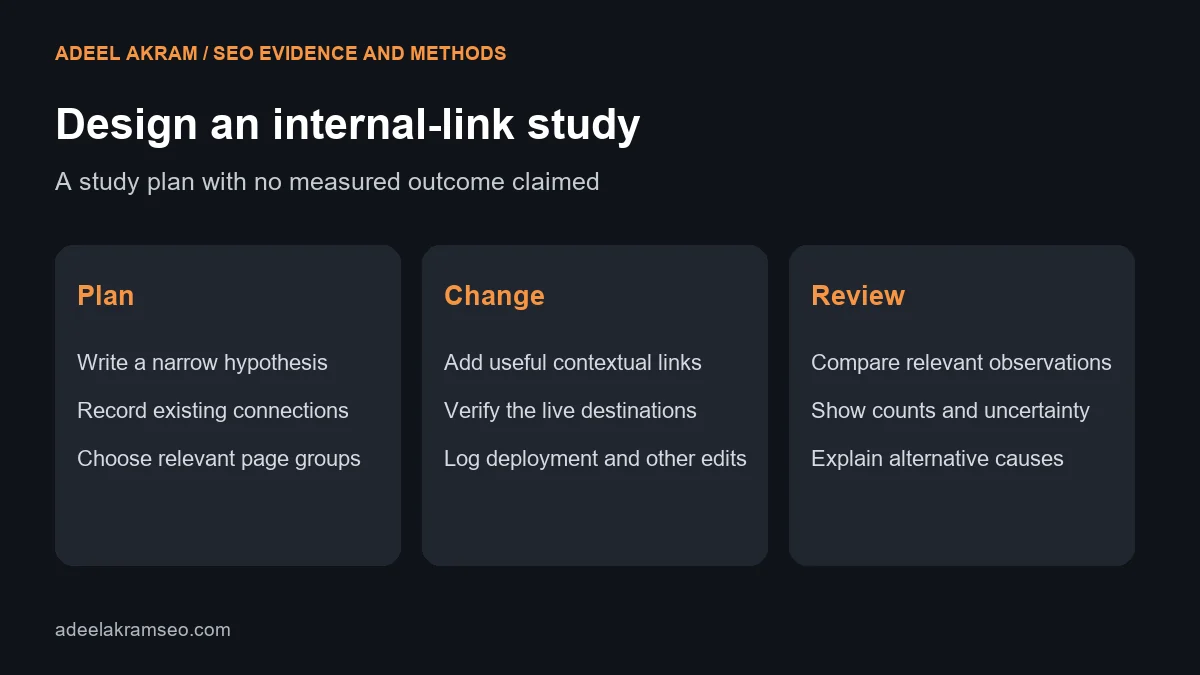
Write a narrow hypothesis
Choose a page group with a specific connection problem. For example, important service resources may receive few relevant contextual links from related articles. The hypothesis could be that adding useful connections improves discovery or helps visitors reach the next relevant page.
Define the primary question before selecting metrics. A discovery question may use crawl and indexing observations. A navigation question may use relevant page transitions. A search-performance question needs a more careful comparison of impressions, clicks and query context.
Do not combine every desired outcome into one vague objective called “SEO improvement.” The test should make clear what evidence would support the hypothesis and what would leave it unresolved.
Select pages that allow a meaningful comparison
Choose a manageable group with comparable purpose and enough baseline information. Exclude pages undergoing a simultaneous redesign, major content replacement or migration where those changes would overwhelm the interpretation. Record exclusions and their reasons.
Where appropriate, identify a comparison group that does not receive the planned change. Review whether its topic, seasonality and starting condition are similar enough to be informative. A comparison group improves context without automatically making the study a controlled causal experiment.
Map existing links and page relationships before editing. Note important navigation links as well as contextual links. A count alone does not establish whether the connection helps the reader.
Capture the baseline and intervention record
| Record | What to capture | Why it matters |
|---|---|---|
| Hypothesis | Specific expected behavior | Prevents changing the success definition later |
| Page groups | Included and excluded URLs | Defines the scope |
| Existing links | Source, destination and context | Shows the starting condition |
| Search baseline | Relevant periods and query segments | Supports later comparisons |
| Visitor path baseline | Relevant navigation observations if available | Separates user behavior from ranking claims |
| Intervention | Exact source, destination and anchor changes | Makes the work reproducible |
| Other changes | Content, template and campaign releases | Exposes competing explanations |
| Review plan | Observation window and limitations | Prevents premature conclusions |
Add links that serve the reader
Choose destinations that answer a natural next question. Use descriptive anchor text and place the link in relevant context. Avoid inserting the same commercial phrase everywhere merely to increase a count.
Google’s link guidance describes crawlable links and useful anchor text. Follow those foundations while keeping the main task readable. A large number of irrelevant links does not make the page more helpful.
Check that each destination works and represents the intended canonical page. Avoid unnecessary redirect chains or links to unpublished resources. Confirm the rendered link rather than relying only on the editor.
Verify deployment before starting the observation window
Record the live implementation date and inspect every planned connection or a documented representative set where the scale requires it. Check that caching or template conditions did not prevent the links from appearing.
Review mobile usability and the surrounding text. A technically present link can still be difficult to understand or interact with. The test should preserve the article’s useful answer rather than sacrifice it for the measurement.
Keep the original link record so the team can review or reverse the intervention if needed. Do not change the same group repeatedly during the observation window without documenting the new phase.
Compare relevant observations with context
Use comparable reporting periods and segment the pages or queries that relate to the hypothesis. Review demand, position changes, new content and other releases. A site-wide traffic increase can come from a different section and say little about the intervention.
Report counts alongside percentages. If a page had very few visits, a small numerical difference can produce a large relative increase. That may be an observation worth recording without supporting a general conclusion.
If a comparison group moves similarly, discuss that pattern. If the intervention group differs, review whether starting conditions or other changes explain the difference. Do not present the comparison as proof beyond what the study design supports.
Report negative and uncertain results
A useful study can find no noticeable change, mixed outcomes or insufficient data. Preserve those findings instead of changing the success metric after the fact. Explain whether the links still improve navigation even when the search effect remains uncertain.
Separate verified implementation from outcome interpretation. The links may be live and relevant while a ranking conclusion is unresolved. A credible report can state both without calling the test a failure or inventing a win.
For the wider website context, use the SEO audit checklist. Other access or content issues may need attention before an internal-link experiment becomes the most useful priority.
Questions about an internal linking SEO experiment
Does adding more links guarantee higher rankings?
No. Use relevant connections and assess the recorded evidence. Link count alone does not establish a search outcome.
Should the study change titles and content too?
Avoid unrelated simultaneous changes when testing a narrow linking hypothesis. If changes are necessary, record them and limit the causal conclusion.
What if the sample is too small?
Report the counts and uncertainty. Extend the appropriate observation or choose a more informative scope rather than presenting unstable rates as a reliable effect.
Has this experiment already been performed?
No. This is a study design with no measured outcome reported. A finished account requires actual baseline, change and review records.
Make the experiment worth interpreting
Choose a narrow page group, define the hypothesis and record the original links before implementing the change. Preserve the observations and explain alternative causes. For help auditing page relationships, request an internal-link review. A useful experiment makes its uncertainty visible.