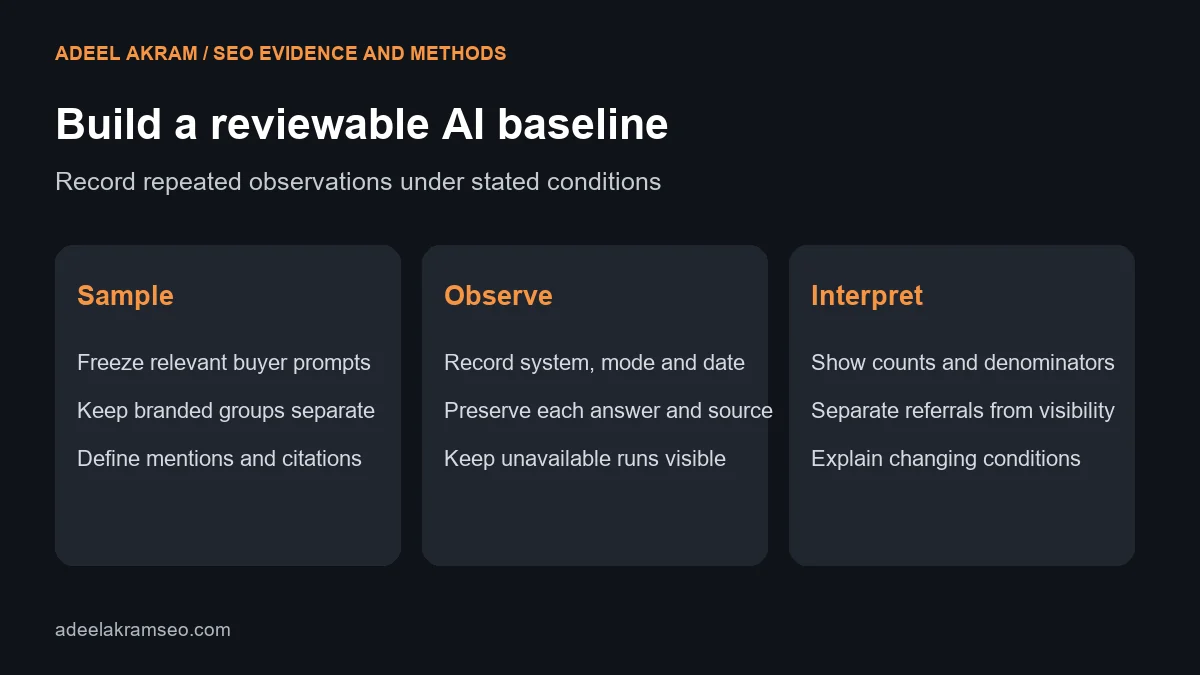
An AI visibility study should record repeated observations under stated conditions. One answer that mentions a business is not a stable market-share measure, and one answer that omits it does not prove the business is invisible everywhere. Define the sample, preserve the responses and separate mentions, citations and website referrals.
This article is a baseline-study protocol. No prompt run, citation rate or improvement result is invented. Use the method to gather a real evidence set before comparing later changes.
Define what visibility means in the study
A brand mention names the business. A citation or supporting link identifies a source. A recommendation may describe a provider without linking to it. A website referral records a visit observed by the measurement system. These signals are related but not interchangeable.
Choose a primary question, such as whether the business appears in a defined set of relevant service questions. Record secondary observations without turning every signal into a single score. A linked source and an unlinked mention should remain distinct.
Build prompts from real buyer questions
Collect questions that represent the audience’s actual decisions. Include relevant services, markets and language where appropriate. Avoid a sample consisting only of prompts that explicitly name the business; those test a different condition from unaided discovery.
Keep branded, non-branded and location-specific groups separate. Record why each question belongs in the sample. Do not repeatedly rewrite a question until the desired business appears, then present only the successful version as the baseline.
Freeze the first prompt set before collection. Later additions can form a new version. This makes comparison clearer than changing the denominator whenever a new question gives a more favorable result.
Record the conditions of each observation
| Field | What to record | Why it matters |
|---|---|---|
| Prompt version | Exact question and group | Prevents hidden wording changes |
| System and mode | Named product and visible mode | Different systems can behave differently |
| Date and time | Collection timestamp | Responses and products can change |
| Location and language | Known observation context | Local and language conditions affect relevance |
| Session conditions | Relevant visible settings and context | Prior interaction can affect comparability |
| Response evidence | Preserved answer and source links | Supports later coding review |
| Visibility coding | Mention, citation or recommendation separately | Avoids conflating different signals |
| Unavailable observation | Failure or missing feature as its own status | Prevents selective removal from the denominator |
Repeat observations without manufacturing certainty
Use a consistent repetition plan over the chosen collection period. Record each run even when the answer differs or the feature does not appear. Repeated observations reveal variation within the sample; they do not automatically represent every user or all market demand.
Avoid treating multiple near-identical runs as independent people. A small collection of prompts can be useful for diagnosis but may not support precise market-wide percentages. Explain the sample size and limitations beside any reported rate.
Preserve failures and unavailable observations. Decide in advance whether a rate uses all planned runs or only valid observed answers, and show the denominator. Different denominators can produce different percentages from the same records.
Code mentions and citations consistently
Define what counts as the business’s name and how ambiguous names will be handled. Confirm that a citation points to the intended website or entity. A link to an unrelated person with a similar name is not a successful identity observation.
Record source URLs and distinguish a link to the business from a third-party mention. Review a sample of coding with another qualified reviewer if the study requires it. The purpose is to reduce subjective interpretation, not to count every favorable phrase as a recommendation.
Do not send private client or customer information into prompts merely to make them realistic. Use public service questions and appropriate anonymized context. Preserve the evidence in a controlled internal record before publishing a summary.
Review technical access separately from answer inclusion
Google’s AI feature guidance explains that supporting links in AI Overviews and AI Mode require indexed, snippet-eligible pages, with no additional special file or schema requirement. Eligibility does not guarantee selection.
For other systems, check the provider’s current documentation and the relevant crawler purpose. OpenAI’s crawler documentation distinguishes search access from training-related crawling. Do not assume one robots rule controls every use.
Record actual access evidence rather than inferring a block from one missing mention. A content or entity issue can differ from a technical access issue. The SEO audit checklist helps establish the wider page-access baseline.
Keep referral reporting within its limits
Website analytics can record some referrals when a person follows a link and measurement works. It does not observe every answer view, unclicked citation or private recommendation. A zero referral count does not prove the business never appeared in an answer.
Google states that AI-feature traffic is included in overall Search Console Web performance reporting. Do not label the entire Web total as AI-only traffic. Keep direct answer observations and website acquisition reports as separate evidence streams.
Use inquiry feedback and business records where useful, but avoid attributing every later brand search to the prompt study. The study records visibility conditions, not the complete customer journey.
Compare later periods without changing the study silently
Keep the prompt set and observation conditions as consistent as possible. Note product updates, mode changes and sample revisions. If conditions change materially, explain whether the periods remain comparable.
Record website changes and other public sources that may have changed during the interval. An increase in mentions after a page edit does not isolate the edit as the cause. Report the association and plausible alternatives rather than a guaranteed optimization effect.
Questions about an AI visibility study
Does one citation prove strong visibility?
No. It is one observation under stated conditions. A baseline needs a relevant sample and repeated records.
Should branded and non-branded prompts be combined?
Keep them separate because they test different discovery conditions. A named-business prompt is not the same as an unaided service question.
Can referrals measure every AI mention?
No. Referrals describe observed visits, not all answer appearances or influences.
Has this baseline study been completed?
No. This is a collection protocol with no measured citation or mention result reported.
Collect a baseline that can be reviewed
Freeze the questions, define the coding rules and preserve every planned observation with its conditions. Then report mentions, links and uncertainty separately. For help evaluating access and public business information, request a visibility review. A useful baseline shows both the observations and their limits.