
A local SEO case study should explain why a landing page was useful for a genuine service area, what changed and how the business assessed suitable inquiries. It should not replace a city name on a generic page and attribute every later lead to that edit.
This guide is a case-study method, not a report of a completed client project. No local ranking, lead count or revenue gain is invented. Use the evidence plan to document a real page and its limitations.
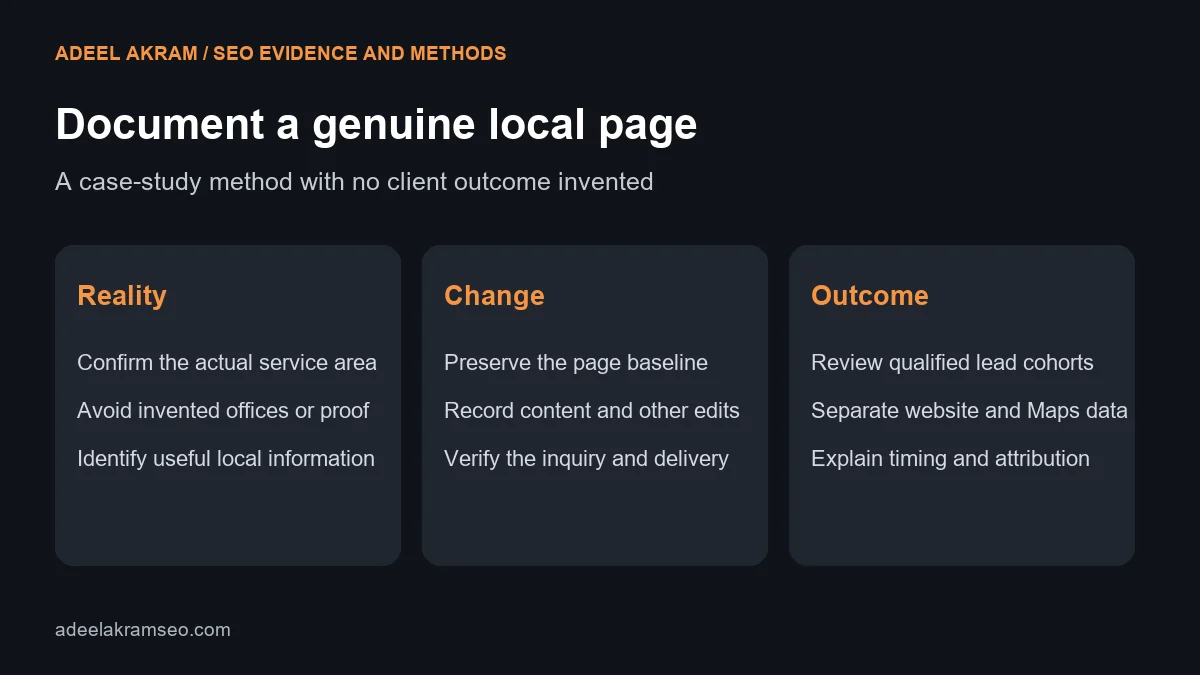
Confirm the location and service reality
Identify the actual business model: a staffed customer-facing location, a service-area business or another genuine arrangement. Explain which services the business provides in the area and what information a buyer needs to judge suitability.
Do not invent an office, address or local team to support the page. A service area is not automatically a physical branch. Keep business profiles and website statements aligned with the real operation and current platform requirements.
Google’s Business Profile guidelines provide the relevant foundation for profile representation. The website page should also make the business’s actual service arrangement understandable to readers.
Define the page problem and baseline
Record whether the existing page fails to explain coverage, service fit, process or a usable next step. Preserve the URL, content, headings and inquiry path before editing. Include relevant search and lead records where they are reliable.
Separate website performance from Maps observations. The two surfaces have different contexts. A page improvement and a Business Profile change during the same period should appear as separate interventions in the record.
Note the available sample and data gaps. If tracking was broken or the page had very few relevant visits, a precise before-and-after lead rate may not be supportable. Keep the limitation visible from the beginning.
Plan useful local information
Include service coverage, practical constraints and the process for requesting help. Add genuine local details that affect the decision, such as the supported area or an actual delivery arrangement. Avoid unsupported claims about being the leading provider in a city.
Use real evidence where permission and records support it. A relevant project example can explain the method, but do not invent customer names, testimonials or measured gains. If evidence is unavailable, state the process and deliverables clearly.
Google’s spam policies describe doorway abuse. Review whether each location page provides a distinct useful destination rather than serving only as a route from many query variations to the same generic offer.
Create the case-study evidence record
| Record | Evidence to preserve | Interpretation limit |
|---|---|---|
| Business reality | Actual location or service-area arrangement | A page does not establish a new branch |
| Baseline page | URL, content and contact path | An old screenshot is not a lead baseline |
| Relevant visibility | Query, page and surface context | Website and Maps data are different |
| Content change | Exact sections and purpose | Longer content is not automatically better |
| Other interventions | Profile, campaign and website edits | They can influence the same outcomes |
| Inquiry measurement | Verified successful action and delivery | A click is not a qualified lead |
| Lead qualification | Consistent suitability criteria | More submissions can include poor fit |
| Outcome review | Dates, counts and unresolved records | Association does not prove a single cause |
Verify the page and inquiry path after release
Inspect the public URL, title, headings, links and mobile layout. Confirm that the page describes the intended service accurately. Check any location details against the business’s current records.
Complete a controlled inquiry test and verify receipt. Test validation errors and confirm the intended event does not count unsuccessful actions as leads. Record the live release date and test result.
Use the SEO audit checklist for the surrounding technical context. A page study is difficult to interpret if indexing, redirects or measurement have an unresolved defect.
Review suitable inquiries with the sales team
Define qualification before examining the result. Service fit, genuine location needs and timing may matter. Keep spam, duplicates and requests outside the service scope separate.
Follow leads by their creation period and show later outcomes with an appropriate observation window. A contract signed after release may originate from an earlier inquiry. Do not mix those groups to produce a more attractive close rate.
Ask prospects how they found the business where useful, but treat recall as additional evidence rather than perfect attribution. A person can encounter a profile, a recommendation and a website page before contacting you.
Report the result with alternative explanations
Compare equivalent relevant periods and describe changes in demand, campaigns and service availability. Include the page intervention date and other website or profile changes. A lead increase after publication is not enough to isolate the page’s effect.
Report counts and the available context even when results are mixed. If the page became clearer but the commercial outcome remains uncertain, say so. A case study can document a useful improvement without pretending it proved a ranking gain.
Protect private client and customer information in any published account. Use appropriate permission and anonymization, and preserve the evidence internally for review. Do not manufacture details to replace records that cannot be shared.
Questions about a local SEO case study
Does every city need a separate page?
Only create a page when it serves a distinct useful need and accurately represents the business. A city-name variation alone does not establish value.
Can I claim a branch from a service-area page?
No. Describe the actual service arrangement and avoid invented locations or addresses.
Should Maps rankings and website leads be combined?
Report each signal according to its surface and definition. Connect them carefully without assuming they describe one complete journey.
Is this a completed local client case study?
No. It is an evidence and review method. A completed account needs actual baseline, intervention and outcome records.
Document the local value before the outcome claim
Confirm the real service area, preserve the baseline and explain how the page helps a buyer. Test the inquiry path and review suitable outcomes with their limitations. For help assessing local pages and website evidence, request a local SEO review. A credible local case study starts with a genuine business reality.