
To prioritize SEO fixes, connect each finding with the affected pages, the business consequence and the evidence supporting it. A large audit does not mean every warning deserves immediate work. The useful order depends on severity, reach, confidence, implementation effort and dependencies.
This guide explains a practical decision method using hypothetical audit situations. It does not claim that the examples represent a client project or measured outcome. Use the framework to turn a warning list into a manageable implementation plan.
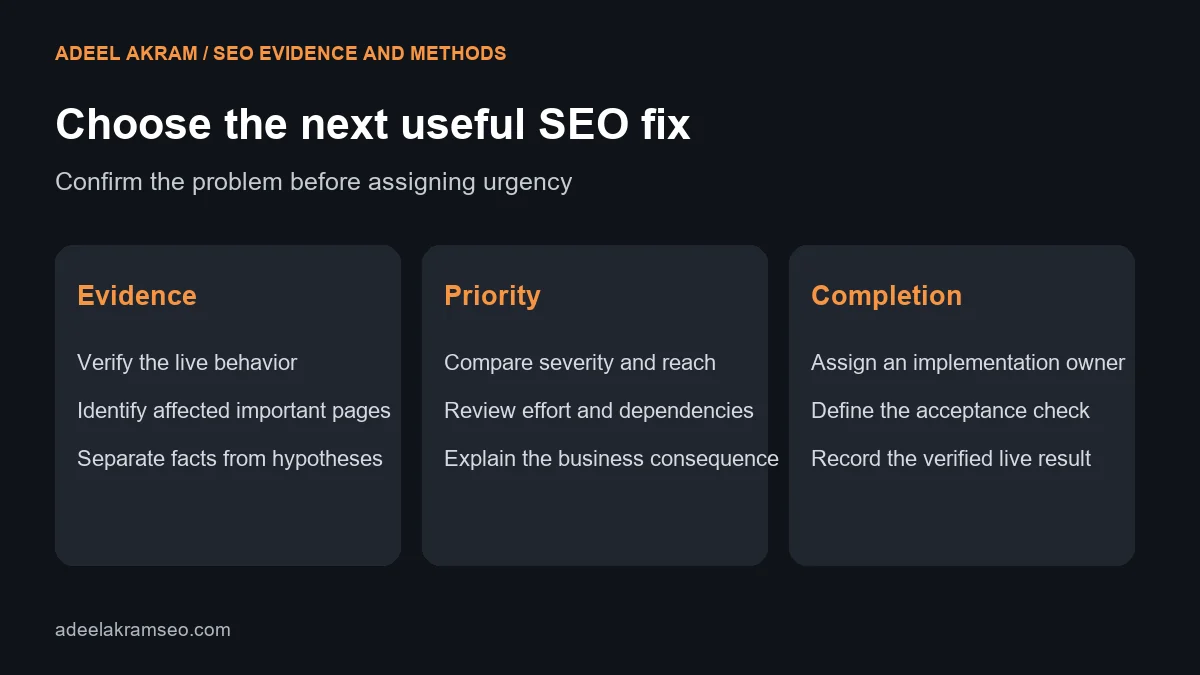
Confirm the issue before ranking its urgency
Check the finding on a representative live page. A crawler warning can describe an intentional behavior, an outdated URL or a low-value section. Record what the page actually does and why that behavior matters to the intended audience.
Separate confirmed defects from opportunities and unanswered questions. “The main contact form fails on mobile” has different evidence from “A longer page might perform better.” Do not assign both the same confidence simply because a tool lists them together.
Use the SEO audit checklist to organize the investigation. The checklist supports coverage; the page and business evidence determine the priority.
Consider severity and reach together
A severe problem affecting important pages usually deserves attention before a minor issue affecting an obscure archive. Identify which services, templates and user journeys the issue touches. Count meaningful affected pages rather than every parameter variation a crawler discovered.
A site-wide template defect can have broad reach, while one broken high-value inquiry path can have a direct business consequence. Neither is automatically more important without context. Explain the consequence and the affected audience.
Use a decision record rather than a mysterious score
| Factor | Question | Evidence to record |
|---|---|---|
| Severity | What fails or becomes difficult? | Observed behavior and consequence |
| Reach | Which important pages or users are affected? | Relevant URLs, templates and journeys |
| Confidence | How certain is the diagnosis? | Live checks, data and remaining uncertainty |
| Business value | Does this affect a priority service or outcome? | Offer, demand and inquiry context |
| Effort | What work and review are required? | Developer and content estimates |
| Dependencies | What must happen first? | Access, approvals and related fixes |
| Risk | What could the change disrupt? | Affected systems and recovery plan |
| Verification | How will completion be established? | Specific live acceptance check |
Resolve critical access and inquiry failures
Start by examining problems that prevent important pages or contact paths from functioning. Examples include accidental exclusion of service pages, broken redirects after a migration or failed message delivery. Confirm the problem before changing global settings.
For indexing concerns, distinguish crawling, indexing and ranking with the page indexing diagnosis. A low ranking does not automatically mean a robots setting is wrong. A broad change based on that assumption can create another problem.
If the business cannot receive inquiries, review the actual form and delivery workflow. More visibility is unlikely to solve a broken contact path. Assign the repair and test both successful and unsuccessful submission behavior.
Sequence dependencies before easy wins
Some useful changes rely on earlier work. A redirect map needs a reliable URL inventory. A service-page brief needs a clear offer. A lead report needs tested events and qualification definitions. Schedule the prerequisite instead of treating the dependent task as ready.
A quick task can be worth doing when it solves a relevant problem with little risk. It should not displace a critical issue simply because it is easier to complete. Explain the trade-off in the backlog so the team understands why an item moved.
Group related changes where that reduces repeated effort, but preserve verification. A template release may address several pages at once. Record the representative pages checked and inspect any exceptions that use a different layout.
Use priority bands with clear meaning
Define a small number of bands such as urgent confirmed failures, high-value improvements, planned refinements and further investigation. Write the criteria beside the labels. A red badge without a definition does not help the developer decide what to do.
For an uncertain issue, assign an investigation task with an expected decision. Do not ask the team to implement a speculative fix as if the cause is established. Gathering the right evidence can be the highest-priority action.
If you use numerical scores, keep the inputs transparent. A weighted model is a planning aid, not an objective prediction of ranking impact. Review whether the score produces a sensible order under the actual business constraints.
Make each ticket reviewable
Include the issue, affected examples, intended behavior, owner and acceptance check. Add the relevant documentation when a recommendation depends on a search requirement. Google’s Starter Guide is a useful foundation for evaluating common practices without treating every tool suggestion as mandatory.
State what the ticket does not establish. Fixing a technical behavior does not guarantee a particular ranking. A content improvement can make the page more useful without producing an immediate measurable search change. Keep those outcome questions separate from completion.
After release, verify the live page and update the change log. Do not close the issue solely because someone edited the setting. Record any remaining mismatch and decide whether it needs another task.
Review the order as evidence changes
Revisit priorities after a major release, new data or a change in the business goal. A resolved dependency can make an improvement ready. A newly discovered failure can move ahead of planned work. Explain the change instead of silently replacing the backlog.
Keep low-value refinements visible without allowing them to consume the whole plan. The purpose of prioritization is to allocate limited implementation capacity to the most useful next actions. It is not to achieve a perfect score in every tool.
Questions about how to prioritize SEO fixes
Should every critical tool warning be fixed immediately?
Verify its meaning and business consequence first. Tool severity and actual site impact can differ.
Is the quickest task always the best first task?
No. Compare value, urgency, risk and dependencies. An easy refinement should not displace a confirmed failure affecting important pages.
What if the cause is uncertain?
Prioritize an investigation with a clear expected decision. Do not present a guess as a confirmed implementation requirement.
How should completion be checked?
Use the specific live behavior defined in the ticket, then document the result. Search outcomes require a separate observation period and context.
Turn the audit into the next useful batch
Choose a small group of confirmed, valuable tasks with owners and acceptance checks. Resolve prerequisites and review the results before expanding the list. For help diagnosing and ordering the work, request an SEO review. A good priority explains why this action comes next.