
SEO ROI is useful when the calculation makes its costs, outcome basis and attribution assumptions clear. It becomes misleading when a report treats all organic revenue as additional profit caused by SEO. Start with trustworthy lead records and a consistent commercial definition, then show the uncertainty instead of hiding it behind one percentage.
This guide provides a measurement framework and an illustrative calculation. It does not report client results, forecast a guaranteed return or replace the business’s own accounting definitions.
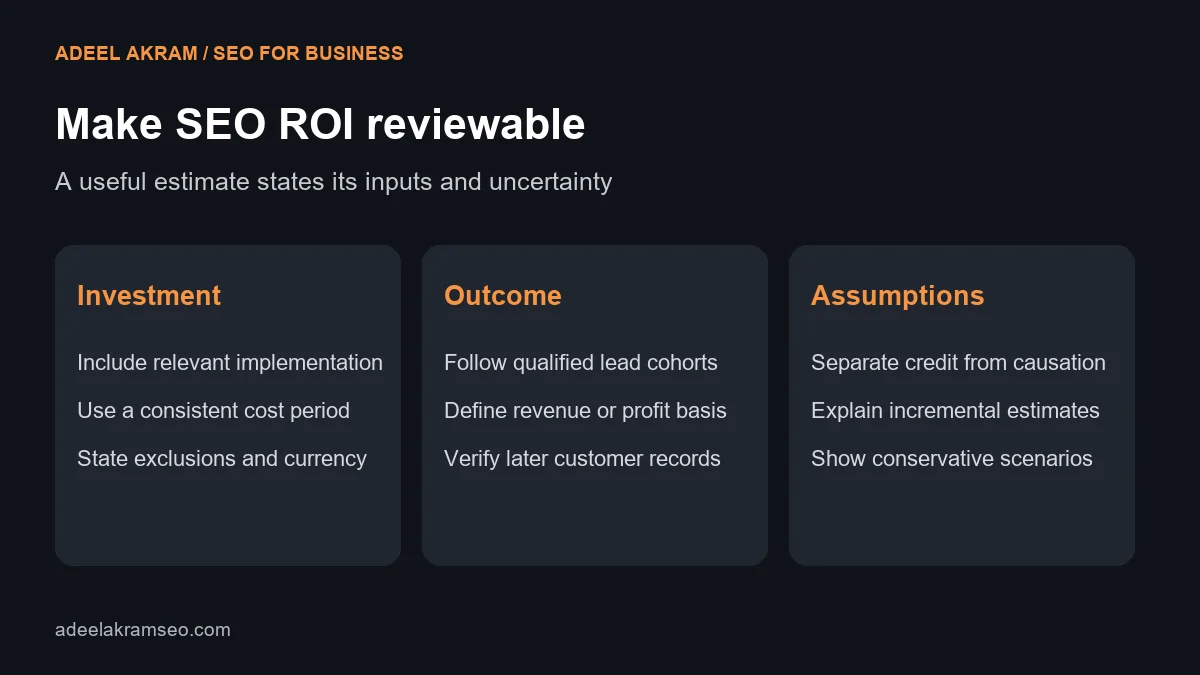
Define the return you intend to measure
Choose whether the report describes revenue, gross profit or contribution after specified delivery costs. These are different measures. A revenue-based return can look attractive even when the service has high fulfillment costs. Agree on the basis with the person responsible for the business numbers.
For a profit-based estimate, use a stated formula: estimated incremental contribution attributable to the work, minus the total SEO investment, divided by that investment. Multiply by 100 for a percentage. The difficult part is establishing the inputs, especially what is genuinely incremental.
Do not label total revenue from recorded organic visits as proven incremental revenue. Some customers might have found the business through brand searches, referrals or other channels. The report should distinguish an attributed association from a causal estimate.
Include the work needed to achieve the outcome
List consulting, development, content production and agreed measurement costs within the selected period. Include relevant internal effort if the business’s reporting method requires it. Avoid comparing a full outcome with only one small part of the investment.
Use a consistent treatment for ongoing and one-time work. A redesign or tracking setup may support several future periods. Explain the allocation method rather than switching it to make the current month look better. Keep the method stable when comparing periods.
Record exclusions and currency assumptions. If the business uses PKR but some invoices use another currency, use the actual agreed accounting basis. Do not compare different periods with unexplained conversions.
Connect inquiries with later business outcomes
Start with reliable successful inquiry records, then apply agreed qualification criteria. Track the lead’s later progress in the business system. A form submission can be useful evidence of interest without representing a customer or revenue.
Follow leads by their creation period when reviewing later outcomes. A contract signed this month may result from an inquiry created several months earlier. Show the observation window so the reader understands whether the group has had time to progress.
Keep duplicate, spam and unsuitable inquiries separate. Review whether the CRM has complete updates before calculating a close rate. Missing outcomes should remain unknown rather than becoming assumed future sales.
Use an explicit input table
| Input | What to document | Common mistake |
|---|---|---|
| Reporting period | Lead cohort and outcome observation window | Mixing unrelated months |
| Investment | Included consulting, content, development and other work | Using only the retainer fee |
| Qualified leads | Consistent suitability criteria | Treating every click as a lead |
| Customer outcomes | Verified later business records | Counting open opportunities as customers |
| Value basis | Revenue or specified profit measure | Calling revenue profit |
| Attribution | Model, scope and missing observations | Treating model credit as complete causation |
| Incrementality | Evidence for additional outcomes | Assuming all organic business is new |
| Uncertainty | Ranges, exclusions and unresolved inputs | Presenting a precise percentage without context |
Work through a clearly hypothetical example
Suppose a business estimates PKR 200,000 in incremental contribution under a stated attribution assumption and records PKR 100,000 in total SEO investment for the corresponding period. The calculation is (200,000 − 100,000) ÷ 100,000 × 100, or an estimated 100% return on that basis. These figures are illustrative, not a result from a client or this website.
If the contribution estimate is only PKR 120,000 under a more conservative assumption, the estimated return becomes 20%. If the business includes another PKR 30,000 of relevant implementation cost, the denominator and result change again. This shows why input definitions matter more than the appearance of a precise percentage.
Keep the assumptions next to the result. Do not place a large ROI number in the headline while burying the qualification criteria, costs and attribution limits in a footnote.
Explain attribution without pretending it is complete
Google’s attribution overview describes how models allocate credit to available touchpoints. That credit can support reporting, but it does not observe every private recommendation, unclicked exposure or offline conversation.
Compare recorded data with prospect feedback and sales notes where appropriate. A buyer may first discover the business in a video and later use a brand search to contact it. Labeling the final visit organic does not establish that earlier influence was irrelevant.
For incremental claims, consider what would plausibly have happened without the work. A carefully designed comparison can help, but seasonality, campaigns and other changes can still complicate interpretation. If the evidence is insufficient, report attributed outcomes and an estimated range rather than a causal certainty.
Use scenarios when the sales cycle is incomplete
For planning, use conservative, central and optimistic assumptions based on available evidence. State the lead count, qualification rate, close rate and value basis used in each scenario. Do not treat the optimistic scenario as the promised outcome.
Avoid projecting a stable rate from a handful of inquiries. Small groups can fluctuate sharply. Show counts and explain how much of the period’s business remains unresolved. Update the estimate when the later outcomes become available.
Technical and measurement work can create useful foundations before commercial outcomes are clear. The SEO audit checklist helps establish a relevant implementation baseline, but completed checks are not themselves a revenue estimate.
Questions about SEO ROI
Can I calculate ROI from traffic alone?
Traffic does not establish customer value or profit. Connect relevant visits with trustworthy inquiry and business records before making a commercial estimate.
Should I use revenue or profit?
Choose the measure that answers the business question and label it clearly. A profit-based estimate needs defined delivery costs and consistent treatment.
Is organic revenue the same as incremental SEO revenue?
No. Recorded organic acquisition and genuinely additional business are different concepts. Explain attribution and the evidence supporting incrementality.
What if the sales cycle is long?
Follow a lead cohort over an appropriate observation window and show unresolved outcomes. Use clearly labeled scenarios for planning rather than claiming realized returns early.
Make the estimate reviewable
Document the cost basis, lead cohort, outcome value and attribution assumptions before calculating the percentage. Review the range and the decisions it supports. For help connecting search work with measurement and inquiry quality, contact Adeel Akram. A useful ROI estimate exposes its assumptions.